Automated vs Manual Pentesting: An Honest Comparison
By Alankar Pande ·
In this guide
Automated testing is good at repeatable breadth: checking many endpoints for known kinds of weakness, quickly and as often as you like. Manual penetration testing adds a person's judgement about your particular application, which matters most for business logic and for attacks that chain several small issues together. The two do different jobs. When a customer, an auditor or your own risk level calls specifically for a manual pentest, automated testing doesn't stand in for it.

What automated testing does well
Automated tools send structured requests and compare the responses with patterns they know. That makes them strong in four areas:
- Known patterns at scale. Missing security headers, outdated components, common injection signatures and exposed debug paths can be checked across hundreds of pages and endpoints.
- Repeatability. The same checks run the same way each time, so you can compare one release with the last.
- Cadence. Tests can run on every deploy or every week, not once a year.
- Cost. Once set up, each extra run costs little.
The NCSC makes a related point from the other direction. It says functional testing of security controls should carry on between pentests, and that spending penetration-testing time on checking whether defined controls work is not a good use of it. Automation is the natural home for that routine checking.
Where automation struggles
Automation is weakest wherever the bug only shows up if you understand what the application is supposed to do.
- Business logic. Applying a discount code twice, skipping a payment step or approving your own expense claim can all look like ordinary traffic to a tool.
- Authorization in context. The OWASP API Security Top 10 puts broken object level authorization first. A tool can swap one record ID for another, but deciding whether user A should see record B means knowing your tenancy model and roles.
- Chaining. Two or three low-severity issues can add up to a serious one, say an information leak that reveals IDs plus an endpoint that trusts them. Seeing the chain takes reasoning rather than pattern matching.
- Sensitive business flows. OWASP notes that API6:2023, unrestricted access to sensitive business flows, doesn't necessarily come from implementation bugs at all. The flow works as coded; the problem is what happens when someone automates it.
Tools also report false positives that someone has to check, and they miss things without telling you, which is the harder problem because nobody notices.
What manual testing adds
Manual testers use plenty of tools. What they add is investigation on top: reading your documentation, noticing an odd parameter, forming a guess about how the server handles it and following that guess. The NCSC observes that penetration tests can't be entirely procedural and that their quality is closely tied to the testers' abilities.
That is also where the costs come from. Manual testing takes scheduling, costs more per day, and happens at a point in time. Two testers given the same scope may also take different routes and report different things, which is a reason to ask about a provider's methodology rather than a reason to avoid manual testing.
| Automated testing | Manual penetration test | |
|---|---|---|
| Best at | Known patterns, breadth, regressions | Logic, authorization, chained attacks |
| Cadence | Continuous or per release | Periodic or event-driven |
| Cost per run | Low | Higher |
| Consistency | High | Depends on tester |
| Business context | Limited | Central |
| Typical evidence | Tool output, ideally verified | Narrative findings with proof |
Using both together
For a small SaaS team, the two usually fit together like this:
- Run automated web and API testing regularly and fix what it finds.
- Bring in a manual tester when the risk justifies it: a major launch, sensitive data, a significant architecture change or a customer requirement. What counts as a significant change helps you decide.
- Share your automated results with the manual tester, so their days go on the problems tools can't see.
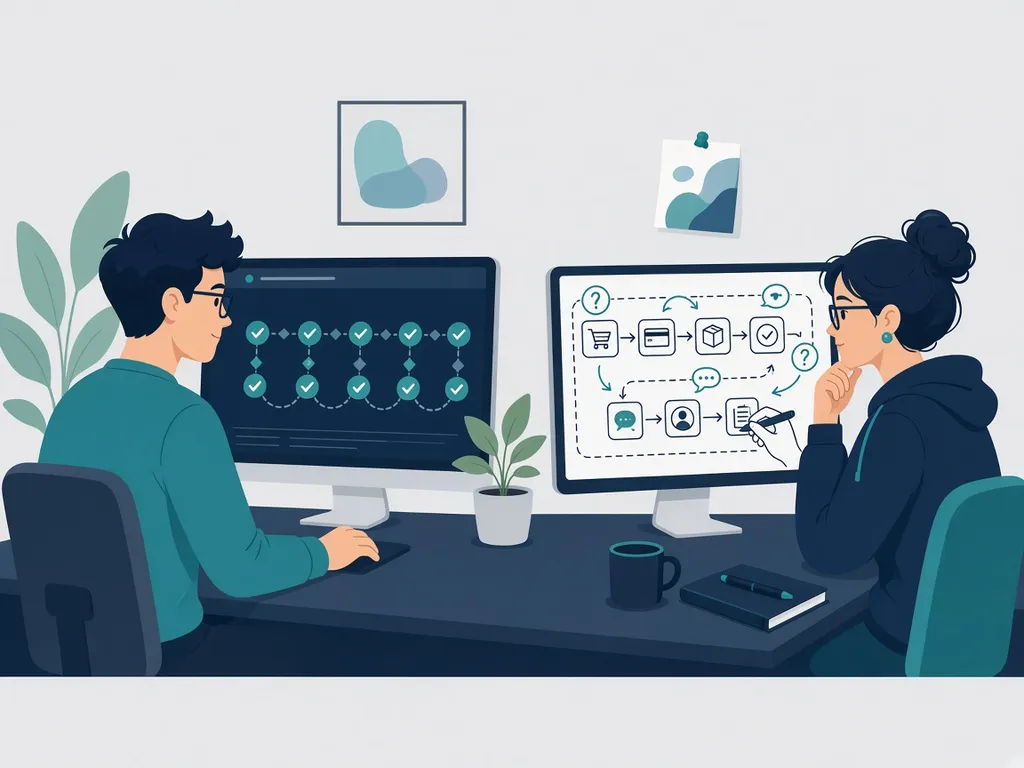
The third step is the one teams skip. A tester who already knows your dependency and header findings won't spend the first morning rediscovering them, and the NCSC's advice is precisely that a pentest should mostly confirm what your own processes already know.
What to ask any provider
Ask what is automated, what a person reviews and what is out of scope. A report of automated findings that a person has read is a different service from a manual penetration test, and the report itself should say which one you bought. How penetration testing works describes the rest of an engagement, from scoping to retesting, around the testing itself.
Where pentest99 sits
PenTest99 is on the automated side: it runs web and API security tooling with AI-agent verification. Its advertised offer is a one-off assessment, not a promise of continuous monitoring or a CI integration. Teams can order another assessment after changes, allowing for the published turnaround. A requirement for human-led manual testing still needs a suitable specialist.
Common questions
Is an automated pentest a real penetration test?
The term is used loosely. When a customer or auditor asks for a penetration test, ask whether they expect manual testing, and describe what you had done in plain terms rather than leaning on a label.
Can AI agents replace manual testers?
AI agents can automate more exploration than a rule-based scanner, for example logging in as two users and comparing what each can reach. They still need tight scope, verified findings and a person accountable for what they do. How AI agents are used in security testing goes into the details.
How often should automated tests run?
As often as you ship changes that matter. Many teams run them on every release to staging, or weekly if they deploy constantly. How often to pentest covers the manual side of the schedule.
Do automated tools find business-logic flaws?
Occasionally, when the flaw has a visible symptom such as an error message. Most logic flaws produce perfectly normal responses, so they need someone who knows what the application was meant to allow.
Sources: NCSC "Penetration testing" guidance; OWASP API Security Top 10 (2023); OWASP WSTG. Sources checked: November 2026.
References
- https://www.ncsc.gov.uk/guidance/penetration-testing
- https://owasp.org/www-project-web-security-testing-guide/
- https://owasp.org/API-Security/editions/2023/en/0x11-t10/
Educational guidance, not a guarantee of security or compliance. PenTest99 uses automated tooling and AI-agent verification; it is not a human-led manual assessment. Scope and limitations matter.